Does structured data actually move AI citations
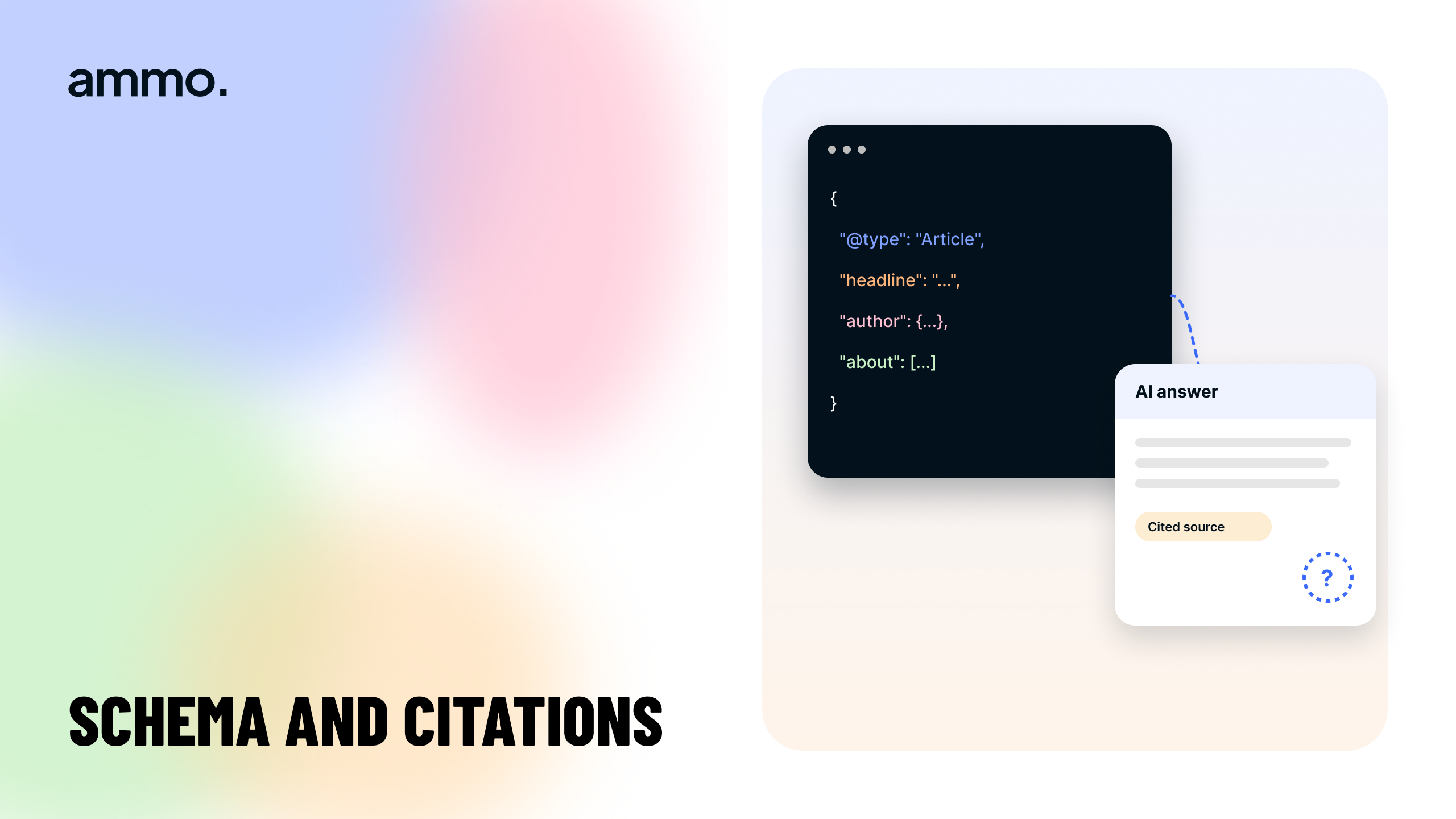
Does structured data actually move AI citations
Schema does not earn citations on its own. AI answer engines cite passages they can lift whole and verify, so the lever is the clarity of the answer in your HTML. Structured data's job is to confirm what the page already says, name the entity behind it and remove ambiguity for a machine reader.
That makes schema a multiplier, not a lever. Marked-up vague pages stay vague. Marked-up direct answers get parsed with fewer guesses, attributed to the right company, and reused with the right dates, prices and authors attached. So schema is not overrated. It is mis-scoped by teams who ship it as a ranking tactic and then wonder why nothing changed.
If you only have budget for one move this quarter, rewrite the first sentence under every heading so it answers the heading. Then add schema.
What schema actually does for a machine reader
Structured data gives a parser facts it would otherwise infer. Inference is where answer engines get your company wrong.
It settles who you are
Organization and sameAs markup tie your name to your profiles and official pages. Without it, a model has to guess which of the four companies sharing your name wrote the page. Entity confusion is the quiet reason a brand gets described accurately in one answer and wrongly in the next.
It locks down the facts that change
Prices, dates, authors, product names and availability drift across a site. Schema states them once in a form that cannot be misread, and it exposes the mismatch when your page body and your markup disagree. That disagreement is a reason to drop you, not cite you.
It makes the shape of the page explicit
Article, FAQPage, HowTo and Breadcrumb markup describe how the content is organized: this is a question, this is its answer, this is step three of five. A retrieval system that can see the boundary of an answer can lift the answer cleanly. One that cannot will lift half of it or skip you.
What actually earns the citation
The pages that get quoted share traits that have nothing to do with markup.
- The answer sits in the first one or two sentences under the heading, with no warm-up.
- Each passage stands alone. It makes sense pulled out of the page, because that is how it will be read.
- Claims carry their source and date in the sentence, not in a footnote.
- The content is in the rendered HTML. Answers that only appear after a client-side fetch are answers a crawler may never see.
- One idea per section. A section making five points gets cited for none of them.
We write about this pattern in more detail in zero-click copywriting for B2B, because the structure that wins a citation is also the structure that wins a skim.
Where schema is overrated
Marking up a page with no answer in it
A FAQPage object wrapped around marketing copy tells a parser exactly where to find nothing useful. Markup describes content. It does not create it.
Chasing every available type
Adding ten schema types to one page does not stack ten signals. It adds ten chances to contradict the page body. Pick the types that match what the page genuinely is and keep them accurate.
Treating rich result eligibility as the goal
Search features change on the platform's schedule, not yours. A strategy built on one rich result format is a strategy with a short shelf life. Build for the machine-readable facts, and treat any rich result you get as a bonus.
Expecting a clean before and after
You cannot A/B test a language model. Answers vary by prompt, by session and by model version. Anyone promising you a measured citation lift from schema alone is selling you a number nobody can produce.
Where schema pays for itself
Entity clarity across a large site
The more pages you publish, the more ways there are to describe the same company. Consistent Organization markup is the cheapest way to keep one description of you in circulation.
Product, pricing and plan pages
These are the pages buyers ask AI assistants about directly, and the pages where being quoted with a wrong price costs you a call. Mark them up and keep the markup in sync with the page.
Author and publication dates
Recency and authorship both weigh on whether a passage is treated as current. If your refresh dates live only in a CMS field that never reaches the page, no reader, human or machine, can see them.
Anything with steps, specs or a defined sequence
Migration guides, implementation steps and comparison content all have a shape. Declaring the shape means the sequence survives extraction.
How to tell whether it moved anything for you
You will not get a clean attribution, but you can get a direction.
- Record a baseline. Run the twenty questions your buyers actually ask across the assistants they actually use, and log who gets cited today.
- Fix the answers first. Rewrite the opening lines under each H2 so they answer the heading in one or two sentences.
- Ship schema second, as its own change, at least a few weeks later.
- Re-run the same questions on the same cadence. Look for shifts in which brand gets named and whether your facts are quoted correctly, not for a single ranking number.
- Watch for corrections more than appearances. Schema's first visible win is usually an answer that stops getting your pricing, name or category wrong.
Put it in the right order
Architecture-First applies here the same way it applies to a rebuild. Content structure comes before markup, and markup comes before volume.
- Write the answer capsule under every heading.
- Make sure the content renders server-side and the page loads quickly.
- Add the entity layer, Organization and sameAs, once, site-wide.
- Add page-type schema that matches what each template actually is.
- Wire schema into CMS fields so it ships with the post instead of needing a developer ticket for every page.
That last point is where most teams stall. Schema that lives in hand-edited code is schema that goes stale the moment the writer changes a price. When markup is bound to CMS fields, the content team updates the fact once and the machine-readable version follows. It is the same reason Ammo rebuilds publishing systems rather than single pages: M13 moved 438 pages in 21 days off Contentful, and work that took three weeks now takes 24 hours or less. Uniqode moved over 74 pages and 400 blog articles and serves 200,000+ monthly visitors. Speed of change is what keeps your facts correct, and correct facts are what get cited.
For the full implementation detail on fields, templates and testing, see the power of structured data in Webflow and the ultimate guide to SEO for Webflow websites. If you want the strategy layer, answer engine optimization is the AEO service we run for B2B teams.
Want to know where your site currently stands with answer engines? Take the free GTM audit. It reviews your site's structure and readiness and gives you a prioritized list you can act on, whether you work with us or not.
Frequently asked questions
Will adding schema get my page cited by ChatGPT or Perplexity
Not by itself. Those systems cite passages they can extract and verify. Schema helps them confirm facts and identify your company correctly, which makes a clear answer more usable. It cannot make an unclear page citable.
Should I add FAQPage markup to every page
No. Add it where the page genuinely contains questions and answers written as questions and answers. Markup that does not match the page content creates contradictions, and contradictions are a reason to skip you.
What matters more, schema or page speed
Both serve the same goal, which is making your content reliably readable. A crawler that times out reads nothing. For context on how speed affects human behaviour, Google and SOASTA found in 2017 that mobile bounce probability rises 123% as load time goes from 1 to 10 seconds, and the HTTP Archive Web Almanac using July 2025 data found only 48% of mobile websites pass all Core Web Vitals.
How long before we see a change
Expect weeks, not days, and expect a directional read rather than a clean number. Answer engines refresh their grounding on their own schedule and vary between sessions, so track correctness and frequency of mentions across a fixed question set over time.
Can our marketing team maintain schema without developers
Yes, if it is built into the CMS. Bind schema values to the same fields the writers already fill in, so updating a price or a date updates the markup. If every change needs a code edit, the markup will go stale.
What does this kind of work cost
Ammo's published plans start at $4,800 / quarter for Growth Support, for companies under 100 employees, and $5,200 / month for Growth Partner, for companies with 100 or more. Growth Partner+ for enterprise scale starts at $15,000 / month. Plans are month-to-month and pricing is subject to change.
Table of contents
Got questions for us? We got you!
Let’s Build What’s Next
Whether you're building your first product or evolving a mature platform, we’d love to help you craft what’s next.